Showing posts with label 1930s. Show all posts

Monday, September 8, 2014

Review Roundup: VIRTUE (1932) / SEARCH FOR BEAUTY (1934)

Hello Readers!  It's been way too long since I checked in -- hope everything's going well with you all.  Things are going great for me because every Friday in September, TCM is playing pre-Codes!  All the lurid goodness you can handle for 24 hours.  Paradise for this film fan!

Two that I enjoyed over the weekend (hooray for DVR):


VIRTUE (1932) is a gritty little melodrama about Mae (Carole Lombard), a prostitute ready to walk the straight and narrow instead of the streets, and Jimmy (Pat O'Brien), the taxi driver she begins a new life with -- only to have the old one rear its ugly, two-faced head.

I was going to write a full review, but Danny at Pre-Code.com has done a marvelous job of that already, so go have a look!   Allow me to add that Lombard is on par with Barbara Stanwyck in this -- the entire film feels more like a down-and-dirty WB production rather than Columbia.  Top-notch and I recommend it highly.


SEARCH FOR BEAUTY (1934) is crazy.  The plot of a health-and-fitness magazine trying to run a beauty contest almost doesn't matter; this whole film is sex on screen with a healthy thumbing-of-the-nose at the Hays Code.  It's gotta be the most salacious of the pre-Codes I've seen (and that's saying something)!  Danny at Pre-Code.com again does the honors with his review.  YOU HAVE TO SEE THIS MOVIE.  Also: Toby Wing Speaks!  She gets actual billing!  

------------------------------

You may wonder why I'm no longer doing my own reviews.  Well, the fact is: there are so many other bloggers that are much, much better at it than I am!  So you'll continue to see poems, actor profiles, and other interesting tidbits on FF+SS, but reviews will be from other film bloggers worth your attention (and boy, are there some wonderful ones)!  I'll still be adding my two cents though. ;)


Thursday, January 9, 2014

Manly P Hall and the Mysticism of 1920s California

This is Manly Palmer Hall.  He was born in Ontario, Canada, on March 18, 1901.  Striking, no?

[image courtesy The Manly P Hall Archive]

Young Manly, accompanied by his maternal grandmother, moved to California to reunite with his mother  in 1919.  (He never knew his father.)  California then was just as much Hippieland USA as it was in the 1960s, maybe even more:

The Victorian Era started the ball rolling with Spiritualism, Theosophy and The Golden Dawn. Between these, all the concepts that would grow and be experimented with through the 20th century emerged: mediuimship/channeling, clairovoyance, astral projection, astrology, mixtures of eastern and western religious concepts, past lives, ceremonial magick, cabalic esotericism for non Jews, the list is endless.

During the 1800s Lodges were how it was done. But in the new 20th century things were changing. People with interesting systems of alternative spirituality were discovering a way to actually achieve stability was to form a little hub in LA...[o]ver the decade as Los Angeles’ reputation grew, it attracted droves of occultists and those wanting to start their own systems of alternative spirituality as well as all the young Hollywood fodder.  ["Los Angeles and the 1920s Occult Explosion", A STEAMPUNK OPERA]

Mom fit in perfectly -- she was a Rosicrucian (a secret philosophical society, Wiki definition here) and a practicing chiropractor. Chiropractic was still in its infancy then, having only been founded in 1895; early on it was still considered a pseudoscience of sorts, containing  heavy doses of metaphysics and spiritualism, so it fit in beautifully to the cosmic Cali atmosphere.

Manly was fascinated and jumped in with both feet, becoming a student of Sydney J Brownson, a "doctor" of phrenology (yup, the "bumps on the head" thing).  Although he only possessed a sixth grade education, he was extremely bright, with a voracious appetite for all things occult and esoteric.   The intense young man took over as preacher for Church of the People in 1919, and became permanent pastor only a few days after his ordination in 1923.

Hall was already a well-regarded lecturer before the age of 21, and wrote over 200 books and pamphlets on mystical and spiritual topics between 1920 and 1950.  It was one such book that created his legacy:  The Secret Teachings of All Ages (1928), a GIGANTIC volume spanning almost every metaphysical topic known to man.  It is still incredibly popular -- over one million copies have sold to date -- and it has never been out of print.  Manly was brilliant, not only in the book's contents, but in its marketing; he created one of the first Kickstarter campaigns, offering copies at a reduced rate for contributions.  He funded Secret's $150,000 publication fees purely through these ads and word of mouth.  

[image courtesy Amazon]


The book made Hall a superstar.  He continued collecting metaphysical knowledge, crossing the globe for rare books and manuscripts.  His trips were funded by benefactors and members of his congregation.  One such benefactor, Carolyn Lloyd (and her daughter Estelle), had been sponsoring Hall since the early 1920s, and upon her death left him a home, $15,000 in cash, and a $10,000 annuity.

He founded the Philosophical Research Society in 1934 --  an organization devoted to "providing resources for the study and research of the world’s wisdom literature".  It is still active today.  Click the logo to visit.  


"But Jen," I hear you asking,  "where's the Hollywood connection?" 
Ah, dear Readers, it's in the stars...


WHEN WERE YOU BORN? (1938) is a crime mystery starring Anna May Wong as Mei Lee Ling, an astrologer who uses her knowledge of the zodiac to solve one murder and possibly prevent others.  Hall wrote the original story for the film, which did terribly on release but has since become quite the cult movie (as you can imagine -- I mean, look at that glorious prologue!).  TCM shows it from time to time, I really want to catch this one.

Hollywood not only knew him, he was friends with most of them  Elvis was a huge fan.  Ronald Reagan borrowed much of his later political posturing from him.  He even officiated at Bela Lugosi's wedding!

[image courtesy The Wild Hunt]

Hall's private life was nowhere near as successful; he married twice, the first ending in suicide, the second an unhappy one with a woman biographer Louis Sahagun refers to as "emotionally abusive".  

Manly P Hall died August 29, 1990, aged 89, under grotesque and suspicious circumstances:

In the ultimate, final tragedy, this man who believed in reincarnation and who had planned to leave the earthly plane consciously, might have been the victim of a greedy plot devised by his assistant Daniel Fritz, who rewrote Hall's will. Hall's body was found under suspicious and horrifying circumstances, apparently dead for hours and with thousands of ants streaming from his nose and mouth. The case was never solved. [Steffie Nelson, "Charting the Man Behind a Mystical City", Los Angeles Times, June 21 2008]


Thursday, November 7, 2013

Corliss Palmer, The Million Dollar Beauty

Every girl is born a princess, blessed by the fairies with beauty, health, joy, charm...at the same time, the evil fairy also was present with her curse.

--Corliss Palmer, "In League With the Fairies", Motion Picture Magazine, March 1921
--------------------

Corliss Palmer was aimlessly thumbing through a fan magazine, just like any other teenager, when something caught her eye:  an unassuming little column at the back of the book, announcing the “Fame and Fortune Contest” for 1920.


“Fame and fortune,” she thought to herself.  “Could you just imagine?”  She could see herself swathed in furs, eating at the finest restaurants, admiring the diamond bracelet on her wrist – and the man on her arm. 

She was pretty, this she already knew.  So did everyone else, since she was crowned “Miss Georgia Peach”.  Sending a photo in seemed like a long shot, but it was worth a try, right?  She cut the coupon out of the ad and set to work.

**

Eugene Brewster, publisher of Motion Picture Magazine, sat listlessly at the heavy wood table.  He’d been rifling through the photos for that infernal contest all morning; he was tired, bored, and his patience was wearing thin.  Until he saw this:


Brewster was known for his eye for the ladies, but he had never seen one like her before.  He was speechless.  He was smitten.

He was also married. 

Had been since 1916.  At that moment, though, his wife was the furthest thing from his mind.

**


So begins the tale of Palmer and Brewster, a sordid little story all too common then – and now. 

Corliss would (surprise!) go on to win the “Fame and Fortune Contest” and was touted as “The Most Beautiful Woman in America”.  Her photos took up a good chunk of the publication.  She’s mentioned so frequently that, if you didn't know better, you’d think her the most famous woman in Hollywood! 


She appeared in a few films, most of which are lost and/or forgotten, save one comedy short: BROMO AND JULIET (1926), featuring a pre-Laurel Oliver Hardy and considered one of Charley Chase’s best.  

[image courtesy Fandor]

Brewster continued to make Corliss his personal project.  He founded a studio for her, CORLISS PALMER PRODUCTIONS, and gave her a (almost certainly ghostwritten) monthly beauty column in Motion Picture Magazine.  These columns led to a spinoff publication, BEAUTY, with you-know-who on the cover.  All his time was tied up in Corliss…and, by this time, the two had become a romantic item as well.

[image courtesy eBay]

“But Jennifer!” you might be saying.  “Didn’t you say he was married?”

Yes he was, Dear Reader.  Eleanor Brewster was NOT happy with the way things were going, calling Corliss “beautiful but dumb” and “nothing but trouble”.   You can't blame her;  Brewster continued to funnel money into Corliss, creating a cosmetics line he heavily promoted in his magazine...


...and buying her a $250,000 mansion to live in (with her mother, of course).  This house was the last straw:

Let him buy whatever houses he wants.  Let him move all over the country.  Let him get a divorce from me.  I'll let him -- at last!  But it will cost him EVERY CENT he has, and that means quite a lot of money.  No woman has ever been through such racking mental stress, such spiritual agony, as I have.  And I intend to see that I get some recompense. 
--"Woes of Lovesick Brewster." Buffalo Sunday Courier, circa 1924.

Eleanor sued for alienation of affection, naming Corliss as co-respondent, and the Brewsters divorced in 1926.  That October, Brewster and Palmer were married.

[image courtesy Fanpix]

From here, things went downhill rapidly.  After the success of BROMO AND JULIET, the rest of Corliss' films did poorly.  Didn't help that Eleanor was true to her word, draining Eugene of most of his fortune.  By 1931, he had filed for bankruptcy (citing "bad investments") and he and Corliss were living in a tiny one-bedroom bungalow.  Not long after, Brewster asked Palmer for divorce.  She agreed, admitting that she never really loved him.

Corliss turned to alcohol to numb the pain and confusion of losing her entire world.

[image courtesy Pieces of our Past]

I was blinded by self-pity...I thought if someone pitied me, they would again give me the fame, love, and fortune that I had let slip through my fingers.

While she did find true love towards the end of her life with Bill Taylor, a rodeo cowboy, she never truly came back from the spectacular rise and fall of the Brewster years.  Corliss Palmer died in 1952, in a California state hospital for the mentally ill.  She was only 50.

[image courtesy Movieart]


Bonus:  Fashion News of 1928.  Skip to 1:44 to see Corliss.


Other Sources:

The Most Beautiful Girl in the World / Love at the End of the Rainbow: Corliss Palmer - An Epilogue -- posted by Scott Thompson at PIECES OF OUR PAST

Lowe, Denise. An Encyclopedic Dictionary of Women in Early American Films, 1895-1930. New York: Haworth, 2005.

"Husband Broke, Beauty Still at Side".  Pittsburgh Post-Gazette, August 7, 1931.

Slide, Anthony. Inside the Hollywood Fan Magazine: A History of Star Makers, Fabricators, and Gossip Mongers. Jackson: University of Mississippi, 2010

Corliss Palmer -- IMDb

All images (unless otherwise noted) courtesy the Media History Digital Library.

Thursday, October 3, 2013

Adults Only! -- Maniac (1934)


Oh man, I wanted to write a review for this -- I really, really did -- but all I managed to get out was "what the hell did I just watch?"  Well, that and  "HAHAHAHAHAHAHAHAHA!"

The Bad Movie Report has a brilliant review here if you want something more intelligent and cohesive.  What follows will be notes I made (after wiping the tears out of my eyes).


THIS IS THE GREATEST BAD MOVIE I HAVE EVER SEEN.


The plot (as if it mattered), from IMDb:

A former vaudevillian gifted at impersonation assists a mad scientist in reanimating corpses and soon goes mad himself.  (Why the hell is a vaudeville guy even working with a scientist?)

Memorable moments:


• Dr Mierschultz listening for a heartbeat on his victim.  IN THE MORGUE.

• More ham acting than a roomful of Barrymores!
• Bizarre intertitles about mental illness that pop up at random times -- with happy music!
• LSD trip double exposures!  
• Suddenly, gratutitous nudity!
• Eating of cat eyeballs!  "It is not unlike an OYSTER or a GRAPE!"
• Continuity?  What's that?  Even the cat has a bad stand-in.
• T & A ending that was mercifully tacked on for the viewers.  

and my favorite line:


"The cats eat the rats, the rats eat the cats, and I get the skins!"


HOLY CRAP this movie is off the rails.  It's made by the same folks who made Reefer Madness, so that should be no surprise.  


Best part of all?  It's available on Youtube.  GO WATCH IT.


Friday, September 27, 2013

The Beautiful Eyes of Blanche Mehaffey

Imagine one of the most embarrassing things you’ve ever done.  Go ahead, I’ll wait.

All set?  Cheeks burning with shame?  Okay.  Now imagine it being on television – your derpiest hour broadcast to hundreds of thousands of people.  You’d be horrified!  You’d be humiliated!  You’d be…

Blanche Mehaffey.

[Photoplay, November 1924]


Blanche was born in Cincinnati, Ohio, but which year is anyone’s guess – 1906, 1907, 1908 have all been mentioned.  She made her way to New York, where she was a dancer in the Ziegfeld Follies.  Florence Ziegfeld himself said she had the most beautiful eyes in the world!  She was also lovely enough to be featured in the more risqué rooftop “Midnight Frolic”. 

Her screen debut was in a Hal Roach production, Fully Insured (1923).  She made somewhat of a name for herself with in Roach shorts, supporting such stars as Snub Pollard and Charley Chase.  Blanche was on the rise, and was about to get even more famous: she joined Lucille Ricksen, Alberta Vaughn, and fellow July birthday girl Clara Bow as a WAMPAS Baby Star of 1924!  (That's her on the bottom right, next to Bow.)

[image courtesy Immortal Ephemera]

So from here she went on to superstardom, becoming a household name into the Roaring Twenties and beyond, right?  Right?!

Sadly, you’ve read enough of these profiles to know where this is headed:  being a Baby Star turned out to be the pinnacle of her career.  She made a few more silent pictures, the most memorable being Westerns with Hoot Gibson, and by the 1930s her output mostly consisted of incredibly low-budget films produced by her husband, Ralph M Like.  She also had the lead in a 1931 serial (also low-budget) called MYSTERY TROOPER. 

Mehaffey changed her name to “Janet Morgan” in the mid-Thirties, in an attempt to reboot her fading career, but to no avail; disillusioned by her body of work, she retired from films by the end of the decade.

[image courtesy The Old Corral]

 Fast forward to 1948.  Television was in its infancy, and a great deal of early programming came from 1930s films – quite the lucrative way for studios to recycle old pictures.  Blanche was startled to find MYSTERY TROOPER on the tube one day, and sued to keep the rest of her less-than-stellar output off the screen.  The suit was dismissed, and she was forced to watch her former films become “golden turkeys”, laughable trifles still featured at "bad" film festivals today. 

Blanche Mehaffey died on March 31, 1968, of natural causes.  She was only 59.


Thursday, June 20, 2013

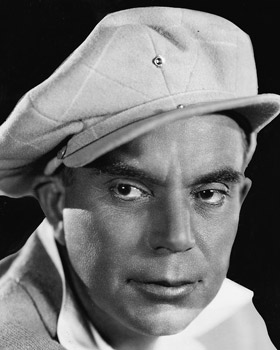
Five Facts About: Roy D'Arcy

[image courtesy eBay]

1.  He was quite the Renaissance man:  born Roy Giusti in San Francisco, he was educated abroad, studied art in Paris, worked odd jobs in South America, traveled Germany and Switzerland with a “gypsy” band, then hit vaudeville and toured Europe and Asia.  He eventually returned to the US, where Erich von Stroheim took one look at him on stage and chose him for Prince Mirko in The Merry Widow (thus beginning his reign as a villain of the silent screen).

2.  Was known for affecting a rather creepy rictus grin; Motion Picture described him as “leering”, the Milwaukee Sentinel labeled him “the erstwhile smiling heavy of the silver sheet”, and Eve Golden called it “death’s head grinning” in John Gilbert: The Last of the Silent Film Stars.  My favorite is Louella Parsons, in a 1927 article entitled “Picture Stars Must Abandon Individuality”:

I have often wondered if Roy D’Arcy did not have his grin and forefinger how he could act.  They are props for him in every screen drama.  Mr D’Arcy made his success in The Merry Widow by affecting a leer…
[image courtesy Allposters]

3.  After he and his wife divorced, he was romantically linked to Lita Grey Chaplin for a time:

Lita and Roy D’Arcy, the dental screen villain [there it is again! – JR] admit to a serious interest in each other...[o]ne report says they will co-star on a vaudeville tour this fall at a large joint salary, another that they will marry and go for a tour to the Orient. [“Gossip of All the Studios”, Photoplay, June 1928]


Lita Grey Chaplin and her stage-door Johnny, Mr Roy D’Arcy…Roy is waiting for one of those leisurely California divorce decrees, to ask Lita to become the second Mrs D’Arcy. [“Gossip of All the Studios”, Photoplay, January 1929]

It all appears to have been for naught, however:

Roy D’Arcy has remarried his former wife, Laura…[a]nd all along we, and lots of other people, were believing that he would soon be the husband of Lita Grey Chaplin.  [“Hollywood High Lights”, Picture Play, December 1929]  (Sadly, the marriage would again be over less than six months later.)


4.  He possessed a lovely singing voice – he headlined as lead tenor in numerous theatre troupe productions, as well as in the stage show Oh Boy!  He later created a vaudeville show called The Greatest Array of Talent Ever Assembled on Any Bill in This Country, but returned to his monologist roots instead of singing.

5.  Although he did make some talkies – the most notable being the serials The Shadow of the Eagle (1932) and The Whispering Shadow (1933) for Mascot – his overwrought acting style was too old-fashioned for 30s audiences, and after a small part in 1939’s The Story of Vernon and Irene Castle, he retired from the screen.  At age 45, he reinvented himself again, starting a profitable real estate business.  Roy D’Arcy died in 1969, at the age of 75.

[image courtesy www.celbcelb.com]


Thursday, May 9, 2013

Review: Two Alone (1934)


Mazie (Jean Parker) lives in a world as bleak and unforgiving as a Grant Wood painting.  An orphan, she was adopted into a life of drudgery and servitude by a harsh farm family, headed by the deplorable Slag (Arthur Byron) and his shrewish wife (Beulah Bondi).  Their daughter, Corie (Nydia Westman, who you'll hear more about soon), doesn't seem to care for Mazie one way or another, only noticing her existence to laugh at her.

Somehow, despite the lack of love and affection, this little weed has grown into a wildflower; Mazie is beautiful, dreamy-eyed, and curious.  Her only friend on the farm is George Marshall (Willard Robertson), an older hired hand, and her heart is broken when he leaves -- though he does promise to come back and save her someday.

One day, Mazie stumbles across Adam (Tom Brown), a troubled young man on the run, and treats him with the first compassion he's ever known.  They recognize something in each other, these two castoffs, and before they know it they've formed a bond -- one they will desperately need to hang on to...


This movie touched me.  It's a soapy programmer, to be sure, and it starts a bit slow and rickety, but the performances are disarming.  Jean Parker imbues Mazie with an innocence that never devolves into dopeyness or gullibilty; both she and Tom Brown have such freshness, such vulnerability, that their love story never seems syrupy or overblown.   Arthur Byron plays one of the coldest, meanest characters in recent memory, and just when you think he might be softening...well, I don't want to give it away.  Charley Grapewin injects a bit of humor into the movie's darker moments with a small but pivotal role, and Zasu Pitts has a cameo as his long-suffering daughter.

Two Alone is a thinly-veiled Cinderella story, but it is also a very real and poignant tale of first love.  IMDb says it is also known as Wild Birds; it's worth seeing under any name.

I give this one:

Thursday, March 21, 2013

"Who Is That?" #1: Louise Closser Hale

There's always that one face -- you know what I mean, that one person that seems to follow you through every movie you watch.  The one constant that pops up so often that you finally throw up your hands (dramatic, I know) and say "WHO IS THAT?"

First one out of the box is this regal lady:

(image courtesy Cinema Fantastic)

Louise Closser Hale's face is well-known to 1930s film nerds: No More Orchids, Faithless, Shanghai Express, Movie Crazy, and Dinner at Eight (among others) all feature her.  She had, however, already enjoyed a long, varied career by the time she played her delightfully acid roles onscreen.

Hale was born in Springfield, Massachusetts (some sources say Chicago, Illinois) in 1872, and studied acting at both the American Academy of Dramatic Arts in New York City as well as Emerson College in Boston.  Although she had her first stage appearance in 1894, it wasn't until Candida on Broadway in 1903 that people took notice -- and not until the London production of Mrs Wiggs of the Cabbage Patch in 1907 that she became a theatrical household name. (Aside: what is it with Wiggs? Seems like every 20s/30s actor got their start in a production of that.  Must investigate.)

(image courtesy Moviesville)

Hale was also an author, penning such works as The Actress, Her Soul and Her Body (later made into a play), and a popular series of travel stories illustrated by her husband Walter Hale.  She was prolific; in
addition to her books, Cliff Aliperti at Immortal Ephemera states she wrote over 150 short stories.  Her signature even graces a former Greenwich Village bookshop door, now treasured as a veritable time capsule of 1920s bohemian literati.

Louise Closser Hale was well into her character-acting incarnation when she had a stroke, possibly brought on by heat exhaustion.  She was rushed to the hospital, where she suffered another stroke -- this one fatal -- the next day.  She was 60.


Thursday, February 28, 2013

Noble Johnson and Lincoln Motion Pictures

I didn't want to let Black History Month come to a close without introducing you to a true pioneer:

Noble Johnson.

 (image courtesy Classic Horror Film Board)

A prolific character actor, his career spanned from the earliest days of cinema through the 1950s.  He is best known today for his roles in King Kong and She Wore A Yellow Ribbon.  His most important picture, however, is arguably The Realization of a Negro's Ambition -- the inaugural film for the Lincoln Motion Picture Company, which he founded in 1916 along with Clarence A. Brooks (also an actor),  Dr. James T. Smith, and Dudley A. Brooks.

(image courtesy Wikipedia)


Jon C Hopwood writes:

In 1916 [Johnson] founded his own studio to produce what would be called "race films", movies made for the African-American audience, which was ignored by the "mainstream" film industry.  The Lincoln Motion Picture Co...was an all-black company, the first to produce movies portraying African-Americans as real people instead of as racist caricatures.  (Noble Johnson IMDb page)

Their first movie was a mature, intelligent drama:

The plot concerned a young engineering graduate of the Tuskegee Institute who leaves the family farm to try his hand in the oil fields of Los Angeles. Turned away because he is Black, the young man rescues a white woman in a runaway carriage. She turns out to be the daughter of the oil company owner, who offers the young man a job with the company's oil exploration team. Later, the young engineer realizes that his parents' farmland shows oil possibilities, and the company owner bankrolls the exploratory drilling tests that eventually prove successful. (Bob Birchard, "Lincoln Motion Picture Company", Hollywood Heritage Summer 2001)

For the average (read: white) audience, used to seeing Black performers relegated to comic relief (or worse), the idea that they could present a sophisticated picture was astonishing.  Seems crazy today, but in 1916 this was a big deal:

The Los Angeles Examiner noted with somewhat condescending amazement that..."colored players can develop histrionic talent above that required for straight comedy.” (Bob Birchard, "Lincoln Motion Picture Company", Hollywood Heritage Summer 2001)

Lincoln started off with moderate success, but financial difficulties, the pressures of leading a double career, and a limited audience caused it to shut down in 1921.  


This did not mean the end for Noble Johnson.  He worked with some of the biggest names of the 1920s:


These included Rudolph Valentino, Buster Keaton, Hoot Gibson, Laura La Plante, John Barrymore, Douglas Fairbanks, George O'Brien, Richard Arlen, Richard Dix, Dolores Costello and William Haines. Of his silent films, several still exist. Some of them are: The Four Horsemen of the Apocalypse, 1921; The Ten Commandments, 1923; and The Thief of Baghdad, 1924 and more. ("Noble Johnson, A Hollywood Original!", African American Registry)


(image, from Moby Dick [1930], courtesy Classic Horror Film Board)


Noble Johnson made his last screen appearance in 1966, and died in 1978 at the ripe old age of 96.


Fun fact:  Johnson moved to Colorado as a young boy, and became great friends with one of his classmates.  Many years later, working in Hollywood, they ran into each other and renewed that friendship.
The classmate?  Lon Chaney.

Tuesday, January 15, 2013

Million Dollar Mystery: James Cruze


Say the name James Cruze, and directing immediately comes to mind: The Covered Wagon, The Great Gabbo, I Cover the Waterfront.  While he’s best remembered for his work behind the camera, his career started long before, in front of it - and not just as daring newsman Jim Norton in The Million Dollar Mystery.  He was the most famous of all the Thanhouser actors...

…and, more than a bit of a bastard.

image courtesy Thanhouser

Born James Vera Cruz Bosen in 1884, his story was memorable (and questionable!) from the get-go:

According to a note in The Billboard, October 1921, "Cruze is a quarter-breed Ute Indian and was born in the Uintah Indian Reservation near Vernal, Utah. His grandmother on his mother's side was burned at the stake for giving birth to a pair of twins. The Indians of the tribe considered this the performance of a witch and took those extreme measures to rid themselves of what they considered a malignant influence." It was said that James Cruze had 17 siblings. He was fond of telling different stories to different interviewers, and over the years many diverse versions of his childhood and early career appeared in print. [courtesy Thanhouser]

He left home by age 16, and began working with the Lubin company in 1910.  By 1911 he had switched to Pathe, and subsequently joined Thanhouser.  In 1913, he married Marguerite Snow, and if you’re a reader of this blog you know what a heavenly match that was.  (Hint: click the link – it wasn’t.)  Their marriage produced his only child, daughter Julie Jane Cruze.

image courtesy Thanhouser

By 1915 he’d been let go from Thanhouser:

When Edwin Thanhouser returned to New Rochelle in early 1915, he made it clear to James Cruze that his services were no longer needed with the firm, and by that time the actor was seeking a change anyway. On May 15, 1915, he and Sidney Bracy, also formerly of the Thanhouser studio, left New Rochelle with mechanic Abraham A. Meltzer and a cameraman, and headed west on a self-arranged publicity tour. [courtesy Thanhouser]

Late 1915 found him deep in debt and needing work, so he met up with Snow in California, and began a stint at Metro.  He did a lot of studio hopping, endng up at Fox in 1917.  Besides Pathe, Metro, and Thanhouser, he had also done time at Kinemacolor, Kimberley, Palo Alto, and Lasky.

Skip ahead a little to 1923.  Cruze, divorced from Snow for a year,  had just directed The Covered Wagon, which brought him much acclaim and the highest salary in the business ($6k per week).  If only his personality had been as great as his work; cameraman Karl Brown gives us a peek:

Karl Brown [stated] Cruze was a drunken, obscene, lecherous individual worthy of little more than contempt…”[he] was now completely free to indulge his own natural urges…he not only did as he pleased, he over-did every chance he got to thumb his nose at whatever is considered polite behavior among civilized people.”  [courtesy Thanhouser]

[image courtesy jamescruze.org]

Cruze married actress Betty Compson in 1925, and by all accounts this marriage was just as wonderful as his first; the drinking, parties, and general debauchery of which he was so fond didn’t even slow down, much less stop, and the police were frequent visitors at their household.  They often split up, but always got back together.

[photo courtesy Silent Ladies & Gents]

From 1927 through 1929, Cruze started his own production company, was subpoenaed in a proceeding concerning one death and several injuries surrounding one of his films, was jailed for refusing to pay an artist for his wife’s portrait, and legally separated from Betty Compson.  By 1930, they were officially divorced, and Cruze was bankrupt.  The rest of the 1930s brought him more debt, more dead-end projects, a real estate court battle with his daughter, and heart problems. His career was officially over by 1941, which also found him married (for the third and last time) to Alberta Beatrice McCoy.  (Happily, he, Marguerite Snow, and Julie Jane were able to mend fences enough for them to be frequent visitors before his death.)

James Cruze died, almost completely broke, on August 3, 1942.  He was 58.

[Richee photo, courtesy LA Times]

Wednesday, August 8, 2012

Dear "Penthouse", I've got quite the sleeper

I was intrigued, while watching "Penthouse", by a pretty brunette with an interesting name: Martha Sleeper.  (The film is a snappy little 1933 gangster picture, worth watching for the chemistry between Warner Baxter and Myrna Loy alone.)  Her face seemed familiar but I guessed she was one of the hundreds of minor starlets, featured in one or two pictures and then relegated to party scenes or chorus lines for the rest of her short career.

Not so with Miss Sleeper, who achieved lasting fame -- though not in the way you might think.


Martha was born in 1910 (some older sources incorrectly say 1907), and by 1924 was under contract to Hal Roach Studios.  She was discovered after a ballet photo of hers caught the eye of director Emory Johnson's mother -- who wrote recommending her for films immediately.   She worked extensively in comedy shorts through the 20s, and her career continued (albeit sporadically) until 1945, when she did her last film, "The Bells of St Mary's".  She then went on to success on the stage before leaving suddenly in 1949.

That same year, she and her husband decided to take a vacation to the Virgin Islands...but once she saw Puerto Rico, it was love at first sight.  She made her home there, spending her remaining years designing and sewing clothes for her own fashion line.  

However, all of that pales in comparison to the reason she is most remembered for today: jewelry.

Martha had always been creative, and in the 30s started making her own baubles out of a sort of papier mache.  They got a lot of attention, says Decotini:

Her earliest pieces, grasshoppers and spiders, were made from paper towels and glue.  Her first tarantulas were arranged in a row down her own sun suit. Delores de Rio and Fay Wray saw her and demanded to know where she got them!  

By 1937, she had a buyer for her line of "gadget jewelry", featuring items you wouldn't expect on necklaces or bracelets:  globes, cigarettes, matches, pencils.  Lots of whimsical animals were featured as well.


Andy Warhol was a huge fan of her work and in the 70s collected it voraciously, almost single-handedly starting the renewed craze for vintage Bakelite.

So there you have it!  From a lovely face in a old film to a pop-art superstar, all in one post.  

If you'd like to learn more about Martha Sleeper's jewelry and fashions, make sure you click the Decotini link above, or: